9 Questions with Sebastien Richard
Our PhDs are playing a significant role within our program, and in the broader industry.
Sebastien is a PhD student at The University of New South Wales (UNSW Sydney) specialising in fluid-structure interaction to optimise the performance of surfboards. He first became interested in modelling and design of surfboards during engineering preparatory classes in France. Sebastien's current work sees him developing design and simulation tools that help manufacturers enhance surfboard performance. More on his project, Manufacturing Automation for Smart Travel Surfboard, can be seen here.
Q1. Under which ACM CRC Research Program does your PhD project sit?
My project is under:
RP1 - Composite Materials
RP2 - Manufacturing Processes
RP3 - Simulation and Performance Prediction
RP4 - Design and Integration
Q2. What is the focus of your PhD?
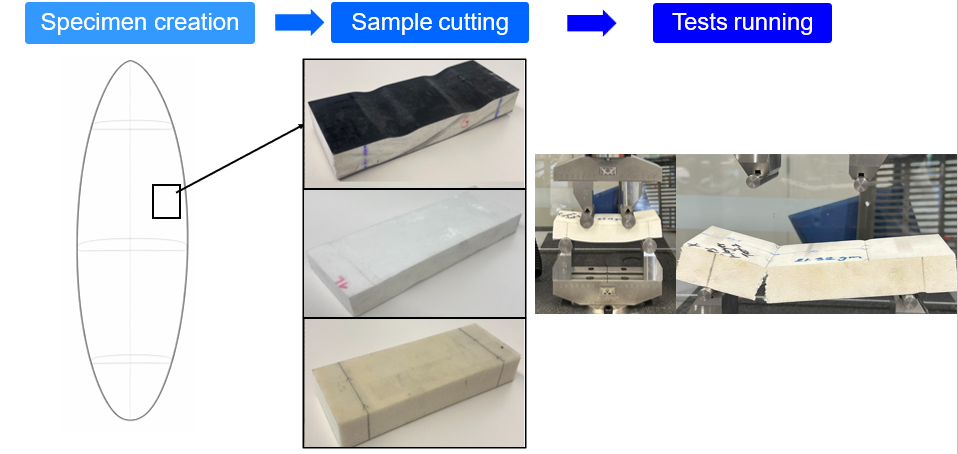
My PhD focuses on the advanced modelling and design of surfboards, with a particular emphasis on composite sandwich structures and lattice-based cores.
Q3. When did you become interested in this field?
I first became interested in this field during my engineering preparatory classes in France. At that time, I had no idea it was even possible to work as an engineer in the surfboard industry. During the Covid period, I finally had time to reflect on what I really wanted to do in the future, and I started researching how to combine my technical background with my passion for surfing.
Q4. What made you interested in it?
I have been surfing for more than 15 years, and it has always been a central part of my life. During my personal time, I also started shaping and building my own surfboards, which made me aware of how toxic traditional board construction can be for the people working with these materials. In parallel, I trained as an engineer and developed a strong interest in composite materials and numerical simulation. I also realised that the same foam materials have been used for more than 50 years, and after breaking several boards myself, I began to question how their robustness could be improved. Understanding that I could combine this practical experience with my engineering skills made surfboard engineering a natural and exciting field for me.
Q5. What do you hope to achieve through your PhD? What challenges are you hoping to solve?
Through my PhD, I aim to provide a more scientific and quantitative understanding of surfboard behaviour, rather than relying only on empirical shaping experience. I am developing design and simulation tools that help manufacturers enhance surfboard performance. Ultimately, I would like to enable the full 3D printing of surfboard cores with spatially variable density and mechanical properties, demonstrating that it is possible to build surfboards in a less toxic way while tailoring their structure to very specific performance requirements.
Q6. What are your long-term goals/ambitions?
In the long term, I would like to work at the intersection of research and industry, helping to bring advanced composite technologies and simulation methods into real surfboard manufacturing. I am particularly interested in contributing to more sustainable and high-performance surfboard. Ultimately, my ambition is to be recognised as a specialist in surfboard engineering and composite structures.
Q7. What’s the best thing about being an ACM CRC PhD student?
The best thing about being an ACM CRC PhD student is the opportunity to work closely with both academic researchers and industry partners. This environment allows me to tackle real-world problems while still exploring fundamental scientific questions. I also appreciate the access to specialised equipment, facilities, and a supportive network of experts in composites and manufacturing.
Q8. What one piece of advice would you give to people thinking of undertaking a PhD in the composites manufacturing area?
My main advice is to choose a topic you are passionate about, because the journey is long and demanding. That passion will help you stay motivated when experiments or simulations fail, and it is often what leads to real breakthroughs and truly original contributions. A PhD in composites manufacturing also requires patience, resilience, and a strong tolerance for trial and error. Finally, it is important to stay connected with industry and constantly think about how your research can create practical value.
Q.9 Tell us something about you that would surprise/impress people.
During my first six months in Australia, I broke three surfboards in the waves, which made it very clear what I wanted to improve during my PhD. Today, surfing has become a small part of my job.
Interested to know more?
Visit our Education and Training page to learn more on our HDR Program, and how it’s helping to achieve industry transformation.